
School and athletic apparel is one of the most relationship-driven markets in decoration. The decorators who get it right build accounts that compound year over year. Clients who never shop around.
We built the 2026 Team Shop Reboot Playbook to put everything we’ve learned from those decorators into one place, and to give you the tools to do the same thing with your own school accounts.
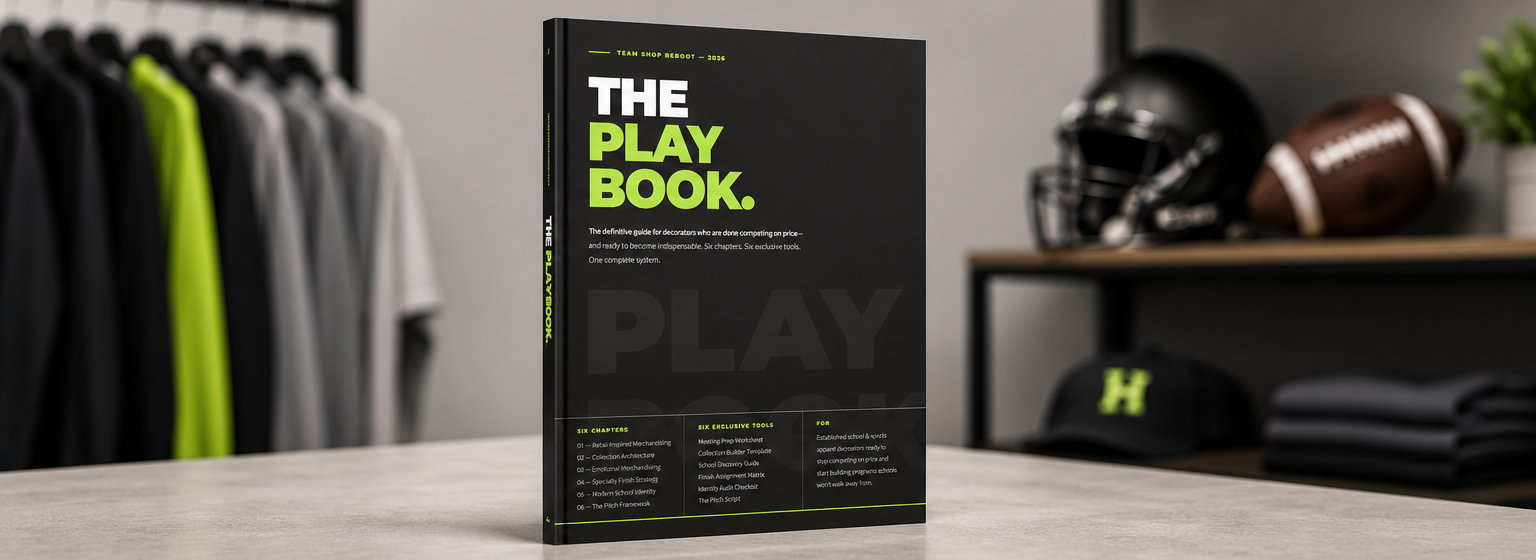
Tools That Go to the Meeting With You
The best thinking in the world is only useful if it shows up in the client conversation. Every chapter in the playbook comes with a working tool built for exactly that moment.
The Meeting Prep Worksheet - Walk in knowing the right questions to ask before the conversation starts.
The Collection Builder Template - Every school program you present looks intentional, cohesive, and worth buying into.
The School Discovery Guide - Identify real problems and solve them rather than pitching features and hoping something lands.
The Finish Assignment Matrix - Put Puff, Vintage Wash, Shimmer, Glitter, Neon, and Glow in the Dark exactly where they belong and support the kind of pricing that makes the work worth doing.
The Identity Audit Checklist - Help schools see the drift in their own branding clearly and understand why it matters.
The Pitch Script - Turn the most important client conversation into the one that sticks.
Behind each tool is a chapter that builds the thinking: Retail-Inspired Merchandising, Collection Architecture, Emotional Merchandising, Specialty Finish Strategy, Modern School Identity, and The Pitch Framework. The whole system, in one place, ready to use.
Ready to Build Something That Lasts?
We built this because the approach works. Better questions open better conversations. Sharper collections close them. A clear plan makes schools feel like they found the right partner before a single order is placed. That is what the playbook delivers, and it’s ready when you are.
The 2026 Team Shop Reboot Playbook is available now.

Frequently Asked Questions
Q: How do decorators build stronger school apparel programs?
A: The decorators with the strongest school programs approach client relationships as ongoing partnerships rather than seasonal transactions. That means showing up to client meetings with a recommendation rather than a catalog, maintaining brand consistency across every order, and thinking about what the program needs next season rather than just what the school is asking for right now. The Team Shop Reboot Playbook gives you the complete framework and tools to do exactly that.
Q: How do you win school apparel accounts without competing on price?
A: By becoming more valuable than a price comparison. Schools stay with decorators who reduce their workload, bring ideas they did not ask for, and make the whole process feel handled. When a decorator shows up with a curated collection, a clear recommendation, and a plan that makes the school feel confident, price becomes much less relevant to the decision.
Q: What should decorators bring to a school client meeting?
A: A recommendation, not a range of options. Schools respond best to decorators who have already done the thinking — specific garments, specific finishes, a clear visual direction, and a reason behind every choice. Arriving with a plan rather than a catalog changes the entire dynamic of the conversation and positions you as a partner rather than a vendor.
Q: How do specialty finishes help school apparel programs?
A: Specialty finishes add perceived value that standard flat prints cannot match and create merchandise students want to wear. Puff adds dimension that makes simple logos feel premium. Vintage Wash creates a retail-inspired lived-in look that competes with what students are already choosing to buy. Shimmer, Glitter, Neon, and Glow in the Dark add excitement to event and limited drops. Used strategically within a collection they support higher pricing and stronger sell-through.
Q: How do you get school apparel clients to stop shopping around?
A: By making the relationship genuinely difficult to replace. That means maintaining consistent branding across every season, storing and reusing artwork rather than starting from scratch, and staying engaged between orders rather than only showing up when there is something to sell. The schools that never shop around are the ones where the decorator has become part of how the program actually runs.
Q: What makes a school spirit wear store convert well?
A: Fewer, better choices. Decision fatigue is one of the most common reasons school stores underperform. When every product feels equally weighted, nothing feels essential and parents leave without buying. A curated selection of three to six strong products anchored to the school's actual colors and presented with intention consistently outperforms a catalog packed with options.