
Better Merch Starts with Better Presentation
TLDR
A story-driven apparel showroom helps customers make decisions with confidence. Instead of overwhelming visitors with every option, effective showrooms guide them through use cases, upgrades, and outcomes. For decorators using heat transfers, this approach builds trust, reduces price-driven decisions, and turns samples into a strategic sales tool.
Most apparel decorators invest heavily in equipment, materials, and production processes. But the way that work is presented often gets overlooked.
At Howard Custom Transfers, we believe a simple truth:
a heat press is a tool, but a showroom is a salesperson.
March’s Better Merch campaign explores how intentional presentation turns samples into sales assets. A strong showroom doesn’t try to show everything you can do. It guides customers toward what works, what sells, and what elevates their brand.
This article kicks off our Showroom Formula with a practical way to rethink how your space, samples, and displays support better conversations, stronger confidence, and higher-value orders.
If your showroom feels crowded, overwhelming, or more like a catalog than a sales tool, this is where to start.
Why Your Showroom Should Educate and Inspire
A showroom should not feel like a warehouse or a catalog brought to life. When customers walk into a space filled with disconnected examples, they are forced to do the work of comparison. They scan racks, walls, and tables trying to understand what matters, what is different, and where to start. That friction slows decisions and shifts the conversation toward price.
For custom apparel decorators using screen printed and DTF heat transfers, showroom presentation plays a critical role in how value, quality, and pricing are perceived. Transfers are often thought of as interchangeable unless their advantages are clearly demonstrated. Without context, customers see prints. They do not see production efficiency, consistency, durability, or the flexibility transfers bring to different order sizes and timelines.
A story-driven showroom does the opposite. It guides the customer through a sequence that mirrors how buying decisions are actually made. Instead of asking, “What do you want to see?” the space quietly answers, “Here is what works, here is why it matters, and here is how it applies to you.”
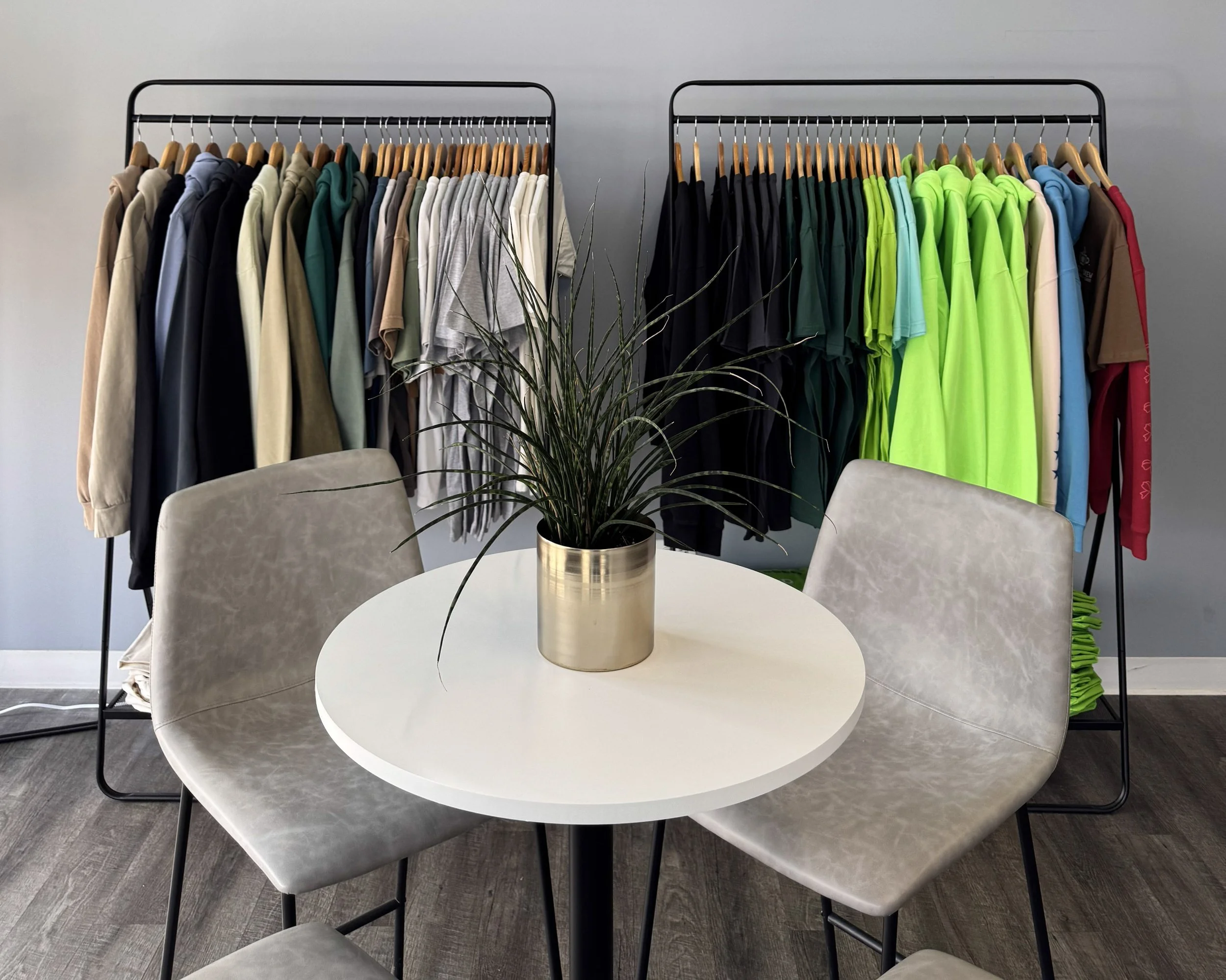
The Problem with Showing Everything at Once in an Apparel Showroom
Many showrooms are built with good intentions. Decorators want to demonstrate range, capability, and experience. The result is often too much information presented without hierarchy. Every garment, finish, and decoration style competes for attention.
When everything is highlighted, nothing stands out. Customers may admire the volume of work, but they leave unsure of what makes one option better than another. In that environment, price becomes the easiest way to narrow choices.
Storytelling Builds Trust and Authority
A story-driven showroom positions you as the guide, not just the producer. It shows that you understand outcomes, not just techniques. Customers are far more confident buying when they feel led by expertise rather than left to browse.
Storytelling also reframes your role. You are not simply selling prints or transfers. You are helping them choose solutions that fit their brand, audience, and budget. That shift builds trust before numbers are ever discussed.
Structure Your Custom Apparel Showroom Like a Sales Conversation
Think about how you naturally talk to a customer. You do not start with every option available. You start with questions, then narrow.
Your showroom should follow the same flow.
Start with a small set of strong, versatile examples that represent your most common use cases. For transfer-based shops, this might include a core lineup of screen printed transfers, full-color DTF transfers, and one or two specialty finishes applied across the same garment style.
From there, introduce upgrades, enhancements, and specialty finishes that build on those foundations. Show how the same artwork behaves differently when produced with different transfer types. Each section should feel like the next logical step, not a separate display.
This approach reduces overwhelm while still demonstrating depth.
Group Apparel Samples by Outcome, Not Decoration Type
Instead of grouping samples by ink, transfer type, or garment category, group them by purpose. Retail merch. Spirit wear. Corporate branding. Fundraisers. Limited runs.
This is where transfers shine. A single design can be shown across multiple garments and order scenarios without reprinting screens or rebuilding setups. Highlight how transfers support fast turnarounds, repeat orders, and consistent results across different fabrics and styles.
When customers see examples framed around goals they recognize, they connect faster. They are no longer asking, “What is this?” They are asking, “Would this work for us?”
This approach is part of what we call The Showroom Formula—a way to design your space around buying behavior instead of production capability.

Create Moments That Invite Questions
The most effective showroom displays spark curiosity. A raised print next to a flat one. A vintage wash finish beside a standard ink. A premium effect shown in a real-world application instead of a novelty design.
Use transfers intentionally to make these comparisons easy. Show the same logo produced with a standard screen printed transfer, a dimensional puff transfer, and a specialty finish. Let customers touch, compare, and ask why one option costs more or feels different.
These moments naturally invite touch, comparison, and conversation. They turn passive viewing into active engagement, which is where value is communicated most clearly. They turn passive viewing into active engagement, which is where value is communicated most clearly.
Less Catalog, More Clarity
A great showroom is not about showing everything you can do. It is about showing the right things, in the right order, for the right reasons.
When your space tells a story, customers feel guided instead of overwhelmed. Decisions come easier. Confidence goes up. And price becomes just one part of a much larger conversation.
Common Questions About Story-Driven Showrooms
Why should a showroom tell a story instead of showing everything?
Showing everything at once creates visual noise and decision fatigue. A story-driven showroom highlights what matters most and leads customers through a logical buying journey.
How does a story-driven showroom increase sales?
It positions you as a guide, not just a vendor. When customers understand why certain options exist and how they apply to their goals, they are more confident and less price-focused.
What should I remove from my showroom?
Remove redundant samples, outdated styles, and displays that do not support a clear outcome. Keep examples that spark conversation and demonstrate value.
How often should a showroom be updated?
The structure should stay consistent, but samples can be refreshed seasonally or as new finishes and trends emerge. Small updates maintain relevance without rebuilding the entire space.
Up Next
Less clutter, more impact. Next week, see how to curate apparel samples that actually lead to revenue and turn every sample into a confident selling moment.